Proper asset management of the railway infrastructure is essential to meet the requirements of todays railway operation today. This work deals with a neglected aspect of track condition: irregularities in the rail surface caused by various phenomena and summarised under the term “short-wave effects”. A macro level evaluation reveals that even short-wave effects with small amplitudes of 0.1 mm accelerate the deterioration of track geometry. When severe short-wave effects are present, track geometry exhibits amplitudes that are 50-120 % higher than the average for the respective track section.The micro-level evaluation includes over 2,000 welded joints across five lines. These are assessed using four load application models to quantify the impact of short-wave effects and define intervention thresholds through statistical analysis. Several potential strategies are presented to counteract short-wave effects. Implementing one or more of the strategies described makes it possible to optimise asset management. Regimes that are currently reactive, preventive, or predictive can be moved to a proactive regime where the root causes of poor system behaviour are addressed before symptoms become apparent.
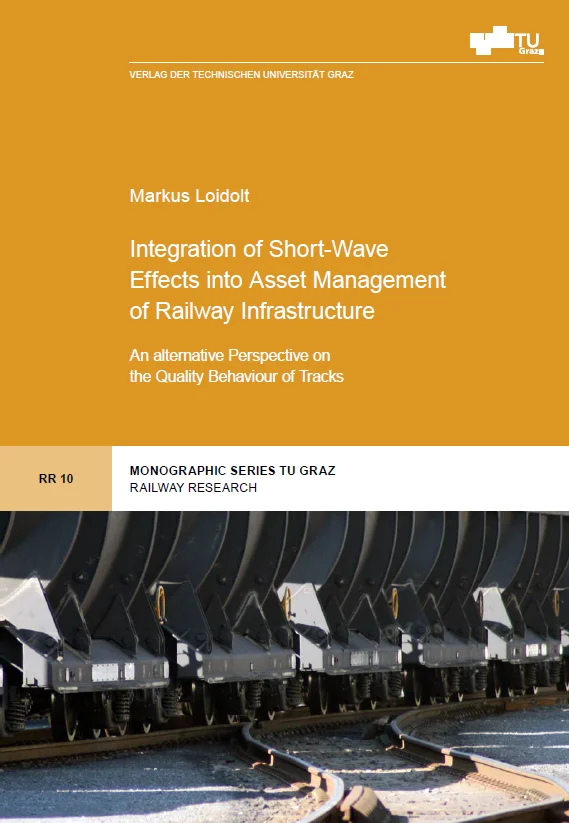
Issue: Open Access E-Book
ISBN: 978-3-99161-114-1
Language: Englisch
Release date: October 2026
Series: Monographic Series TU Graz / Railway Research, Issue 10
Proper asset management of the railway infrastructure is essential to meet the requirements of todays railway operation today. This work deals with a neglected aspect of track condition: irregularities in the rail surface caused by various phenomena and summarised under the term “short-wave effects”. A macro level evaluation reveals that even short-wave effects with small amplitudes of 0.1 mm accelerate the deterioration of track geometry. When severe short-wave effects are present, track geometry exhibits amplitudes that are 50-120 % higher than the average for the respective track section.The micro-level evaluation includes over 2,000 welded joints across five lines. These are assessed using four load application models to quantify the impact of short-wave effects and define intervention thresholds through statistical analysis. Several potential strategies are presented to counteract short-wave effects. Implementing one or more of the strategies described makes it possible to optimise asset management. Regimes that are currently reactive, preventive, or predictive can be moved to a proactive regime where the root causes of poor system behaviour are addressed before symptoms become apparent.
- Catalog
- New releases
-
Open Access publications

- Enhanced e-books
- Series
- Akademische Reden an der Technischen Universität Graz
- Arbeitshilfen für die Praxis
- Archiv und Bibliothek
- Betonkolloquium
- Buddhist Architecture in the Western Himalayas
- BWL Schriftenreihe
- Electrical Power Systems
- Fachbücher Planung und Bau
- Facts & Figures
- Festschriften TU Graz
- Forschungsreihe IBBW
- Forum Technik und Gesellschaft
- Holzbauentwurf+
- Immersive Learning Research Network Conference; Workshop, short papers, poster
- Institut für Gebäudelehre Jahrbuch
- International Brain-Computer Interface (BCI) Meeting
- LM.VM.2014
- Logistik Werkstatt Graz
- Materialien zu Schwerpunkten am Institut für Gebäudelehre
- Mathematical Modelling of Weld Phenomena
- Monographic Series TU Graz
- Monographic Series TU Graz|Advanced Materials Science
- Monographic Series TU Graz|Computation in Engineering and Science
- Monographic Series TU Graz|Geodesy
- Monographic Series TU Graz|Machine Components and Methods of Development
- Monographic Series TU Graz|Production Science and Management
- Monographic Series TU Graz|Railway Research
- Monographic Series TU Graz|Reihe Fahrzeugtechnik
- Monographic Series TU Graz|Schriftenreihe des Instituts Betonbau
- Monographic Series TU Graz|Structural Analysis
- Monographic Series TU Graz|Techno- und sozioökonomisch orientierte Betriebswirtschaft
- Monographic Series TU Graz|Technoökonomie und industrielles Management
- Monographic Series TU Graz|Timber Engineering & Technology
- November Talks
- Proceedings of the International Brain-Computer Interface
- Railway Proceedings
- Schriftenreihe des Instituts für Baubetrieb und Bauwirtschaft
- Schriftenreihe des Instituts für Straßen- und Verkehrswesen
- Schriftenreihe des Instituts für Wohnbau der TU Graz
- Schriftenreihe zur Wasserwirtschaft
- Science, Technology and Society online
- Seminarreihe Bauunternehmensführung
- Studien zur Architektur | TU Graz
- Textbook Series
- Transform Industry: Guiding the transformation of SMEs
- TU Graz Jahresbericht | Annual report
- TU Graz people
- TU Graz Research
- VKM-THD Mitteilungen; IVT-Mitteilungen ab Bd. 100
- Future releases
- Authors
- Sale