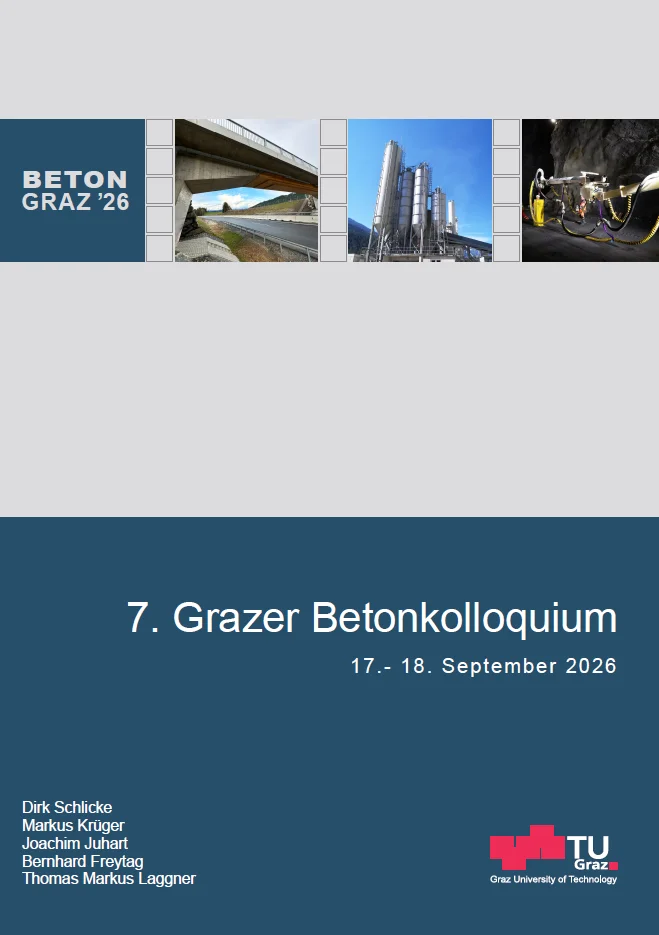
7. Grazer Betonkolloquium

17. / 18. September 2026

Herausgegeben von: Dirk Schlicke , Markus Krüger , Joachim Juhart , Bernhard Freytag , Thomas Markus Laggner 

Issue: Open Access E-Book
ISBN: 978-3-99161-110-3
Language: Deutsch
Release date: September 2026
Series: Betonkolloquium, Issue 7

Building with concrete is more controversial today than ever before. Public perception ranges from seeing it as a material that ‘creates value for generations’ to condemning it as a ‘climate killer.’ Owing to its exceptional versatility, concrete is used on such a massive scale that it accounts for approximately 8% of global anthropogenic CO2 emissions. This is no coincidence, however, as concrete is not only an efficient construction material for many applications but, in numerous cases, simply irreplaceable. As an indispensable material for foundation engineering and tunnel construction, concrete even becomes a key enabler of the transition to sustainable mobility. In the construction of major railway base tunnels, together with their bridges and other civil engineering structures, it plays a crucial role in creating climate-friendly transport infrastructure. This year’s “Betonkolloquium” covers the full spectrum of concrete construction, presenting current projects, the latest developments in standards and regulations, as well as the newest innovations in concrete technology and structural concrete engineering. The successful format of short presentations showcasing innovative solutions from construction practice will be retained and interwoven with the keynote lectures. To foster a broader awareness of the importance of building with high-quality concrete, this year’s predominantly technical program will also be complemented by a historical perspective on concrete construction around 1900.
Building with concrete is more controversial today than ever before. Public perception ranges from seeing it as a material that ‘creates value for generations’ to condemning it as a ‘climate killer.’ Owing to its exceptional versatility, concrete is used on such a massive scale that it accounts for approximately 8% of global anthropogenic CO2 emissions. This is no coincidence, however, as concrete is not only an efficient construction material for many applications but, in numerous cases, simply irreplaceable. As an indispensable material for foundation engineering and tunnel construction, concrete even becomes a key enabler of the transition to sustainable mobility. In the construction of major railway base tunnels, together with their bridges and other civil engineering structures, it plays a crucial role in creating climate-friendly transport infrastructure. This year’s “Betonkolloquium” covers the full spectrum of concrete construction, presenting current projects, the latest developments in standards and regulations, as well as the newest innovations in concrete technology and structural concrete engineering. The successful format of short presentations showcasing innovative solutions from construction practice will be retained and interwoven with the keynote lectures. To foster a broader awareness of the importance of building with high-quality concrete, this year’s predominantly technical program will also be complemented by a historical perspective on concrete construction around 1900.