The environmental impacts of infrastructure are often neglected in large transport projects, yet it is precisely there that considerable potential for ecological improvement can be found. This work integrates environmental impacts into the life cycle management (LCM) of railway infrastructure, combining condition assessment, life cycle assessment (LCA) and life cycle costing into a holistic framework. Using Austrian boundary conditions, the greenhouse gas emissions of the entire network are quantified, revealing that infrastructure provision causes emissions nearly equal to those of daily rail operations. Detailed LCAs identify the main emission drivers and demonstrate that service life is the decisive criterion of sustainability. A decision-making model internalises environmental costs alongside life cycle costs, and a critical-value approach handles uncertainties. Case studies on ballast quality, under-sleeper pads and slab versus ballasted track show that durability-oriented strategies reduce both costs and emissions. The work highlights concrete projects – hydrogen for track construction, green procurement, and innovative ecological construction methods – demonstrating that potential can be unlocked through planning, procurement, technology and asset management.
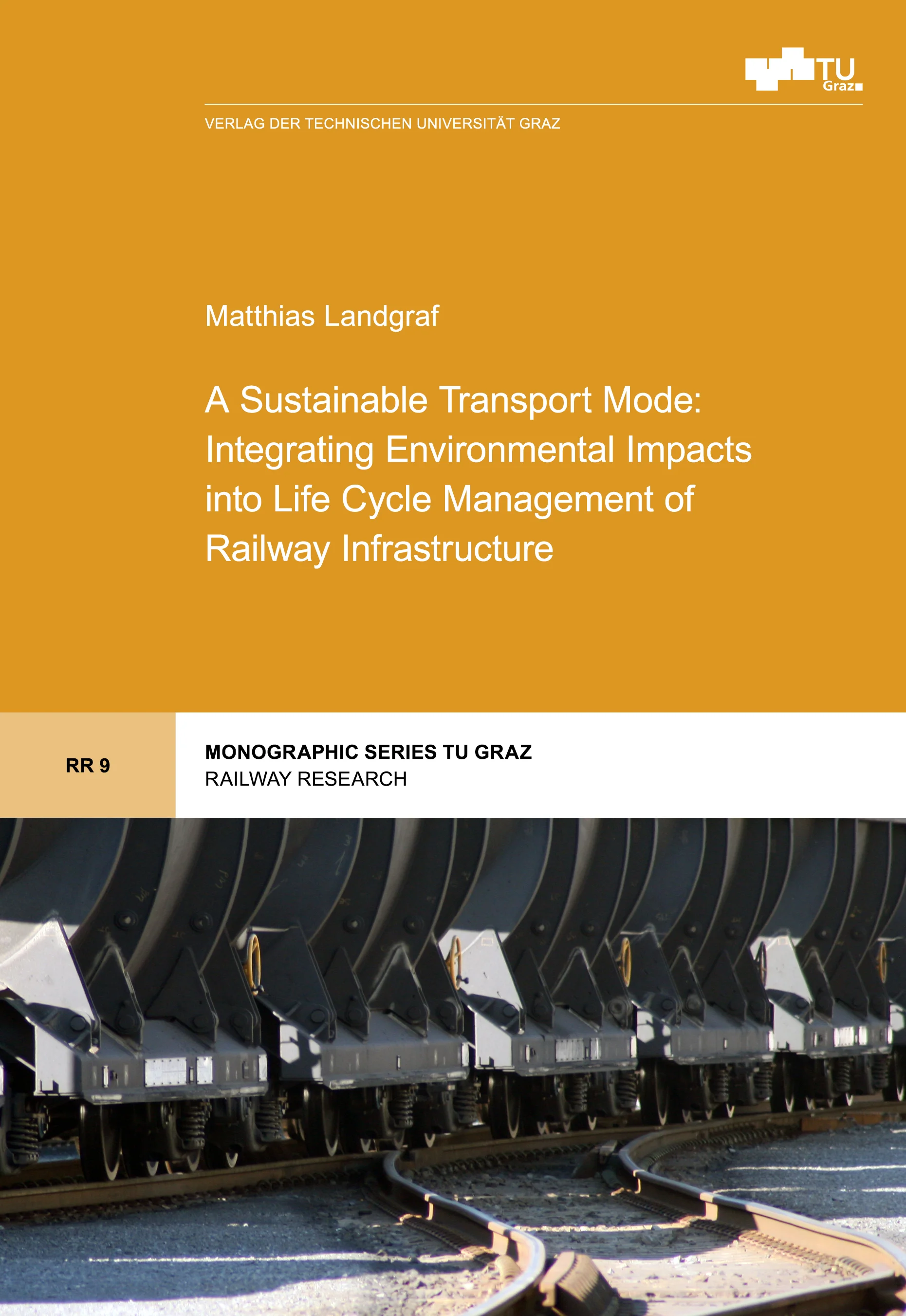
Integrating Environmental Impacts into Life Cycle Management of Railway Infrastructure
Issue: Open Access E-Book
ISBN: 978-3-99161-108-0
Language: Englisch
Release date: August 2026
Series: Monographic Series TU Graz / Railway Research, Issue 9
The environmental impacts of infrastructure are often neglected in large transport projects, yet it is precisely there that considerable potential for ecological improvement can be found. This work integrates environmental impacts into the life cycle management (LCM) of railway infrastructure, combining condition assessment, life cycle assessment (LCA) and life cycle costing into a holistic framework. Using Austrian boundary conditions, the greenhouse gas emissions of the entire network are quantified, revealing that infrastructure provision causes emissions nearly equal to those of daily rail operations. Detailed LCAs identify the main emission drivers and demonstrate that service life is the decisive criterion of sustainability. A decision-making model internalises environmental costs alongside life cycle costs, and a critical-value approach handles uncertainties. Case studies on ballast quality, under-sleeper pads and slab versus ballasted track show that durability-oriented strategies reduce both costs and emissions. The work highlights concrete projects – hydrogen for track construction, green procurement, and innovative ecological construction methods – demonstrating that potential can be unlocked through planning, procurement, technology and asset management.
- Catalog
- New releases
-
Open Access publications

- Enhanced e-books
- Series
- Akademische Reden an der Technischen Universität Graz
- Arbeitshilfen für die Praxis
- Archiv und Bibliothek
- Betonkolloquium
- Buddhist Architecture in the Western Himalayas
- BWL Schriftenreihe
- Electrical Power Systems
- Fachbücher Planung und Bau
- Facts & Figures
- Festschriften TU Graz
- Forschungsreihe IBBW
- Forum Technik und Gesellschaft
- Holzbauentwurf+
- Immersive Learning Research Network Conference; Workshop, short papers, poster
- Institut für Gebäudelehre Jahrbuch
- International Brain-Computer Interface (BCI) Meeting
- LM.VM.2014
- Logistik Werkstatt Graz
- Materialien zu Schwerpunkten am Institut für Gebäudelehre
- Mathematical Modelling of Weld Phenomena
- Monographic Series TU Graz
- Monographic Series TU Graz|Advanced Materials Science
- Monographic Series TU Graz|Computation in Engineering and Science
- Monographic Series TU Graz|Geodesy
- Monographic Series TU Graz|Machine Components and Methods of Development
- Monographic Series TU Graz|Production Science and Management
- Monographic Series TU Graz|Railway Research
- Monographic Series TU Graz|Reihe Fahrzeugtechnik
- Monographic Series TU Graz|Schriftenreihe des Instituts Betonbau
- Monographic Series TU Graz|Structural Analysis
- Monographic Series TU Graz|Techno- und sozioökonomisch orientierte Betriebswirtschaft
- Monographic Series TU Graz|Technoökonomie und industrielles Management
- Monographic Series TU Graz|Timber Engineering & Technology
- November Talks
- Proceedings of the International Brain-Computer Interface
- Railway Proceedings
- Schriftenreihe des Instituts für Baubetrieb und Bauwirtschaft
- Schriftenreihe des Instituts für Straßen- und Verkehrswesen
- Schriftenreihe des Instituts für Wohnbau der TU Graz
- Schriftenreihe zur Wasserwirtschaft
- Science, Technology and Society online
- Seminarreihe Bauunternehmensführung
- Studien zur Architektur | TU Graz
- Textbook Series
- Transform Industry: Guiding the transformation of SMEs
- TU Graz Jahresbericht | Annual report
- TU Graz people
- TU Graz Research
- VKM-THD Mitteilungen; IVT-Mitteilungen ab Bd. 100
- Authors
- Sale