The publication serves as a pioneering guide to a new agenda for housing development in general and for housing design competitions in particular. It provides strategic impulses and establishes how these can be embedded in future planning processes. Contemporary housing development continues to reproduce itself through entrenched decision-making patterns that, taken together, result in uniform, monofunctional solutions. This stagnation is particularly evident in the field of architectural competitions, which remain deeply rooted in a fundamentally functionalist understanding of housing. To formulate a meaningful alternative to this entrenched housing typology, it is first necessary to examine its underlying causes and framework conditions. The focus is therefore not primarily on the aesthetic dimensions of architecture, but on broader socio-political questions: from post-war Graz, through the years of the economic boom of the 1960s and early 1970s, to the subsequent periods of structural transformation leading to today’s neoliberal era. The publication was produced in cooperation with the i_w Institute of Housing at Graz University of Technology and the Chamber of Civil Engineers for Styria and Carinthia.
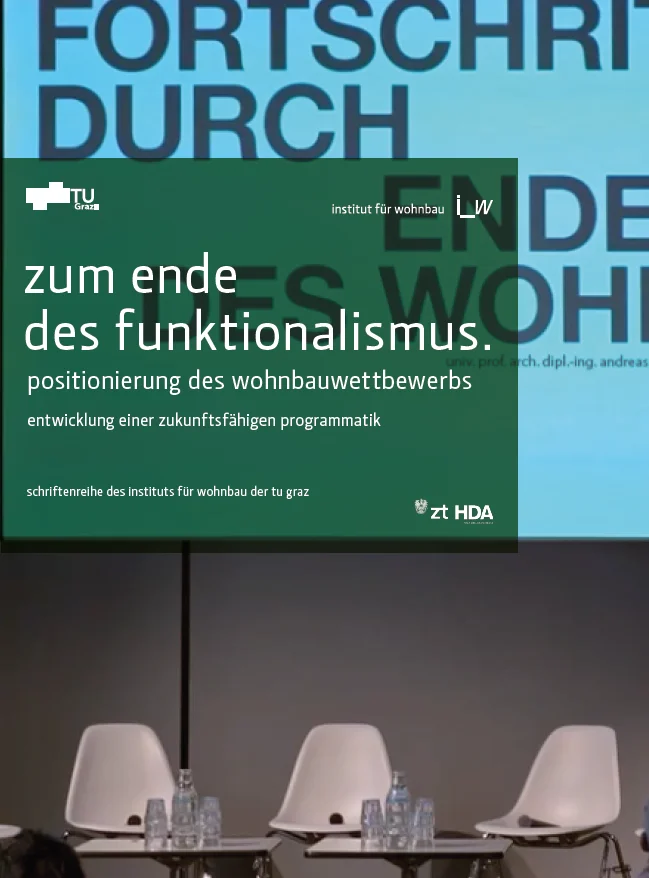
positionierung des wohnbauwettbewerbs
Herausgegeben von: Andreas Lichtblau
Issue: paperback
ISBN: 978-3-99161-112-7
Scope: 364 pages
Language: Deutsch
Release date: October 2026
Series: Schriftenreihe des Instituts für Wohnbau der TU Graz
€ 39.00
The publication serves as a pioneering guide to a new agenda for housing development in general and for housing design competitions in particular. It provides strategic impulses and establishes how these can be embedded in future planning processes. Contemporary housing development continues to reproduce itself through entrenched decision-making patterns that, taken together, result in uniform, monofunctional solutions. This stagnation is particularly evident in the field of architectural competitions, which remain deeply rooted in a fundamentally functionalist understanding of housing. To formulate a meaningful alternative to this entrenched housing typology, it is first necessary to examine its underlying causes and framework conditions. The focus is therefore not primarily on the aesthetic dimensions of architecture, but on broader socio-political questions: from post-war Graz, through the years of the economic boom of the 1960s and early 1970s, to the subsequent periods of structural transformation leading to today’s neoliberal era. The publication was produced in cooperation with the i_w Institute of Housing at Graz University of Technology and the Chamber of Civil Engineers for Styria and Carinthia.
-
TU Graz Fakultät für Architektur (Hrsg.)
Einstimmende Gedanken zur Architektur
OPEN ACCESS E-BOOK
Read more
TU Graz Fakultät für Architektur (Hrsg.)
Einstimmende Gedanken zur Architektur
€ 5.00 Add to cart
Wolfang Tom Kaden, Bettina Gossak-Kowalski, Ernst Alexander Dengg, Anja Zamuda (Hrsg.)
Innovative Holzarchitektur
€ 24.00 Add to cart
Wolfang Tom Kaden, Bettina Gossak-Kowalski (Hrsg.)
Integral Design Studio_Besser spät(i) als nie
€ 19.00 Add to cart
- Catalog
- New releases
-
Open Access publications

- Enhanced e-books
- Series
- Akademische Reden an der Technischen Universität Graz
- Arbeitshilfen für die Praxis
- Archiv und Bibliothek
- Betonkolloquium
- Buddhist Architecture in the Western Himalayas
- BWL Schriftenreihe
- Electrical Power Systems
- Fachbücher Planung und Bau
- Facts & Figures
- Festschriften TU Graz
- Forschungsreihe IBBW
- Forum Technik und Gesellschaft
- Holzbauentwurf+
- Immersive Learning Research Network Conference; Workshop, short papers, poster
- Institut für Gebäudelehre Jahrbuch
- International Brain-Computer Interface (BCI) Meeting
- LM.VM.2014
- Logistik Werkstatt Graz
- Materialien zu Schwerpunkten am Institut für Gebäudelehre
- Mathematical Modelling of Weld Phenomena
- Monographic Series TU Graz
- Monographic Series TU Graz|Advanced Materials Science
- Monographic Series TU Graz|Computation in Engineering and Science
- Monographic Series TU Graz|Geodesy
- Monographic Series TU Graz|Machine Components and Methods of Development
- Monographic Series TU Graz|Production Science and Management
- Monographic Series TU Graz|Railway Research
- Monographic Series TU Graz|Reihe Fahrzeugtechnik
- Monographic Series TU Graz|Schriftenreihe des Instituts Betonbau
- Monographic Series TU Graz|Structural Analysis
- Monographic Series TU Graz|Techno- und sozioökonomisch orientierte Betriebswirtschaft
- Monographic Series TU Graz|Technoökonomie und industrielles Management
- Monographic Series TU Graz|Timber Engineering & Technology
- November Talks
- Proceedings of the International Brain-Computer Interface
- Railway Proceedings
- Schriftenreihe des Instituts für Baubetrieb und Bauwirtschaft
- Schriftenreihe des Instituts für Straßen- und Verkehrswesen
- Schriftenreihe des Instituts für Wohnbau der TU Graz
- Schriftenreihe zur Wasserwirtschaft
- Science, Technology and Society online
- Seminarreihe Bauunternehmensführung
- Studien zur Architektur | TU Graz
- Textbook Series
- Transform Industry: Guiding the transformation of SMEs
- TU Graz Jahresbericht | Annual report
- TU Graz people
- TU Graz Research
- VKM-THD Mitteilungen; IVT-Mitteilungen ab Bd. 100
- Future releases
- Authors
- Sale