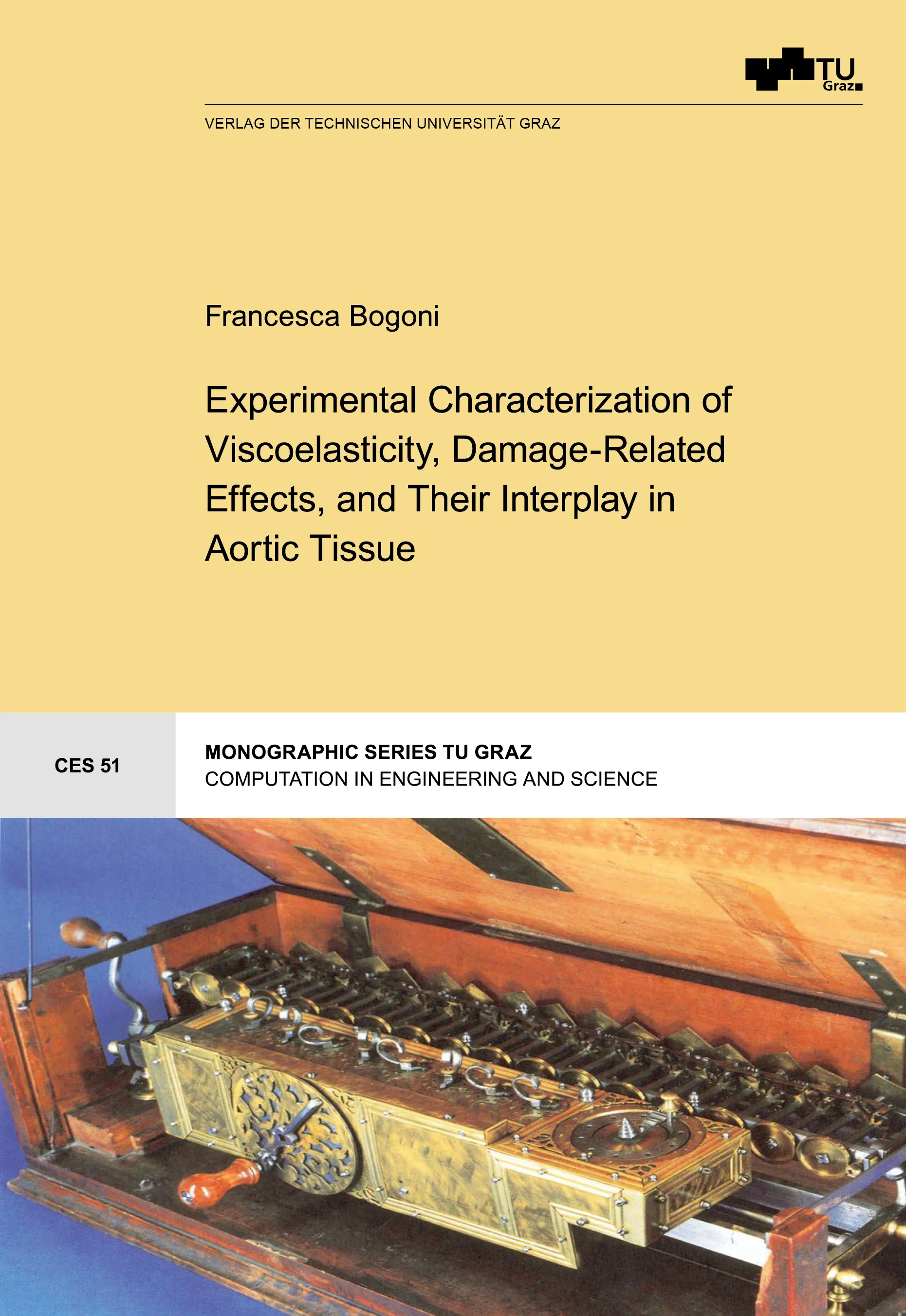
This PhD thesis attempts to advance the understanding of the inelastic behavior of aortic tissue, emphasizing the limitations of a purely elastic description. Due to the presence of viscous and damage-related phenomena, even the relatively simple description of the material as purely elastic requires an appropriate set of data that cannot easily be isolated using standard testing protocols widely adopted in the literature. The first study of this thesis discusses the inadequacy of the common assumption of quasi-stationarity, particularly in approximating the equilibrium response of the aorta through continuous cyclic protocols at low stretch rates. As an alternative to the latter, multi-step stress relaxation tests are adopted to better approximate the equilibrium behavior. To demonstrate the aforementioned aspects, two types of loading protocols are used in equibiaxial extension on the porcine descending thoracic aorta. A framework for the quantification of experimental uncertainties is presented, together with a discussion of the experimental results in terms of energy dissipation and the interplay of inelastic phenomena.
The subsequent study investigates the dependency of the stress state at the end of a relaxation process on the rate of deformation in porcine aortic tissue. Following the methodology of the preceding work, multi-step stress relaxation protocols at varying transient stretch rates are used to investigate further the rate dependence of the equilibrium relation. To obtain more information on the interplay between viscous and damage-related phenomena, the protocol is extended to include a second cycle. Prior to this, an investigation of the spatial homogeneity of the deformation field, which represents a prerequisite to making proper statements on the material behavior solely based on quantities measured during an experiment, is presented. Anisotropic inelastic effects and the presence of an interaction between viscosity and damage are revealed by the collected experimental evidence. The testing methodology initially defined on the porcine aorta is subsequently applied int he final work included in this thesis, which aims to investigate the influence of risk factors for cardiovascular disease, namely high homocysteine and cholesterol, on the biomechanics and microstructure of the descending thoracic and abdominal aortas in a rabbit model of atherosclerosis. Different techniques are used, including equibiaxial extension tests, multi-photon microscopy, and histology. Changes in the mechanical properties, remodeling of the microstructure of the tissue, and calcification in the medial layer are observed as a consequence of the different treatments. More importantly, high homocysteine, with and without high cholesterol, and the presence of atherosclerosis seem to have an influence on the viscoelastic behavior of the aorta. In turn, changes in viscoelasticity could serve as a potential indicator of structural remodeling.
Issue: Open Access E-Book
ISBN: 978-3-99161-125-7
Language: Englisch
Release date: November 2026
Series: Monographic Series TU Graz / Computation in Engineering and Science, Issue 51
This PhD thesis attempts to advance the understanding of the inelastic behavior of aortic tissue, emphasizing the limitations of a purely elastic description. Due to the presence of viscous and damage-related phenomena, even the relatively simple description of the material as purely elastic requires an appropriate set of data that cannot easily be isolated using standard testing protocols widely adopted in the literature. The first study of this thesis discusses the inadequacy of the common assumption of quasi-stationarity, particularly in approximating the equilibrium response of the aorta through continuous cyclic protocols at low stretch rates. As an alternative to the latter, multi-step stress relaxation tests are adopted to better approximate the equilibrium behavior. To demonstrate the aforementioned aspects, two types of loading protocols are used in equibiaxial extension on the porcine descending thoracic aorta. A framework for the quantification of experimental uncertainties is presented, together with a discussion of the experimental results in terms of energy dissipation and the interplay of inelastic phenomena.
The subsequent study investigates the dependency of the stress state at the end of a relaxation process on the rate of deformation in porcine aortic tissue. Following the methodology of the preceding work, multi-step stress relaxation protocols at varying transient stretch rates are used to investigate further the rate dependence of the equilibrium relation. To obtain more information on the interplay between viscous and damage-related phenomena, the protocol is extended to include a second cycle. Prior to this, an investigation of the spatial homogeneity of the deformation field, which represents a prerequisite to making proper statements on the material behavior solely based on quantities measured during an experiment, is presented. Anisotropic inelastic effects and the presence of an interaction between viscosity and damage are revealed by the collected experimental evidence. The testing methodology initially defined on the porcine aorta is subsequently applied int he final work included in this thesis, which aims to investigate the influence of risk factors for cardiovascular disease, namely high homocysteine and cholesterol, on the biomechanics and microstructure of the descending thoracic and abdominal aortas in a rabbit model of atherosclerosis. Different techniques are used, including equibiaxial extension tests, multi-photon microscopy, and histology. Changes in the mechanical properties, remodeling of the microstructure of the tissue, and calcification in the medial layer are observed as a consequence of the different treatments. More importantly, high homocysteine, with and without high cholesterol, and the presence of atherosclerosis seem to have an influence on the viscoelastic behavior of the aorta. In turn, changes in viscoelasticity could serve as a potential indicator of structural remodeling.
- Catalog
- New releases
-
Open Access publications

- Enhanced e-books
- Series
- Akademische Reden an der Technischen Universität Graz
- Arbeitshilfen für die Praxis
- Archiv und Bibliothek
- Betonkolloquium
- Buddhist Architecture in the Western Himalayas
- BWL Schriftenreihe
- Electrical Power Systems
- Fachbücher Planung und Bau
- Facts & Figures
- Festschriften TU Graz
- Forschungsreihe IBBW
- Forum Technik und Gesellschaft
- Holzbauentwurf+
- Immersive Learning Research Network Conference; Workshop, short papers, poster
- Institut für Gebäudelehre Jahrbuch
- International Brain-Computer Interface (BCI) Meeting
- LM.VM.2014
- Logistik Werkstatt Graz
- Materialien zu Schwerpunkten am Institut für Gebäudelehre
- Mathematical Modelling of Weld Phenomena
- Monographic Series TU Graz
- Monographic Series TU Graz|Advanced Materials Science
- Monographic Series TU Graz|Computation in Engineering and Science
- Monographic Series TU Graz|Geodesy
- Monographic Series TU Graz|Machine Components and Methods of Development
- Monographic Series TU Graz|Production Science and Management
- Monographic Series TU Graz|Railway Research
- Monographic Series TU Graz|Reihe Fahrzeugtechnik
- Monographic Series TU Graz|Schriftenreihe des Instituts Betonbau
- Monographic Series TU Graz|Structural Analysis
- Monographic Series TU Graz|Techno- und sozioökonomisch orientierte Betriebswirtschaft
- Monographic Series TU Graz|Technoökonomie und industrielles Management
- Monographic Series TU Graz|Timber Engineering & Technology
- November Talks
- Proceedings of the International Brain-Computer Interface
- Railway Proceedings
- Schriftenreihe des Instituts für Baubetrieb und Bauwirtschaft
- Schriftenreihe des Instituts für Straßen- und Verkehrswesen
- Schriftenreihe des Instituts für Wohnbau der TU Graz
- Schriftenreihe zur Wasserwirtschaft
- Science, Technology and Society online
- Seminarreihe Bauunternehmensführung
- Studien zur Architektur | TU Graz
- Textbook Series
- Transform Industry: Guiding the transformation of SMEs
- TU Graz Jahresbericht | Annual report
- TU Graz people
- TU Graz Research
- VKM-THD Mitteilungen; IVT-Mitteilungen ab Bd. 100
- Future releases
- Authors
- Sale