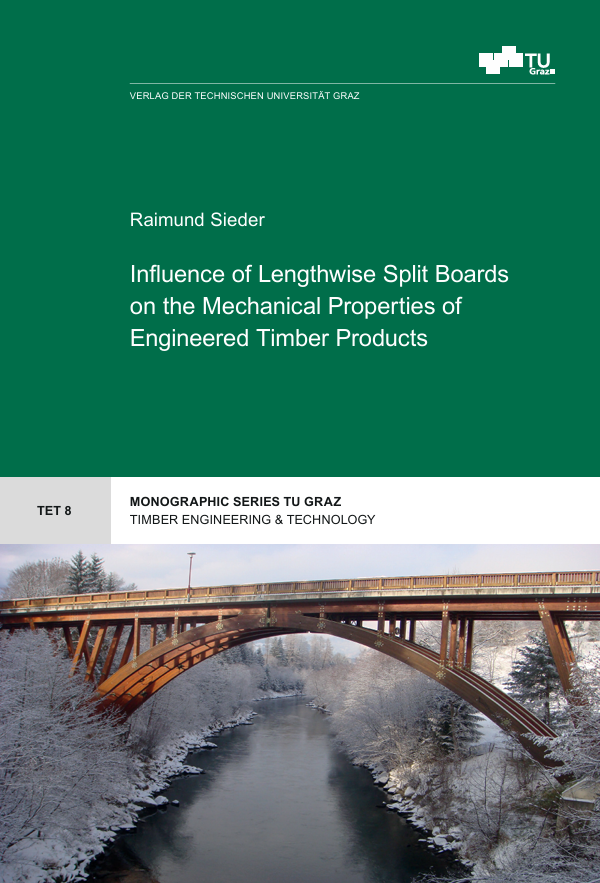
The bending strength and elastic properties of engineered timber products such as glulam (GL T) and cross laminated timber (CL T) are commonly described via load-bearing models based on the tensile properties parallel to the grain of boards and finger joints. These models assume that strength graded boards remain unsplit in the final product. In practice, however, products can be lengthwise split (e.g. resawn glulam) or may include a significant share of split lamellas, as in CL T beams or slabs. After splitting, the assigned strength class no longer applies. Lengthwise split lamellas also occur in the novel products flex_GLT and flex_CLT. The first part covers the develops a probabilistic board model capable of describing knot distributions and tensile properties not only for full-section but also for lengthwise split boards. Combined with a newly developed stochastic-numerical beam model, the load-bearing behaviour of beams containing such split lamellas can be calculated. The model covers products with uni- or orthogonally oriented lamellas and is validated by tests. System and size effects as well as the influence of split lamellas are analysed. Finally, load bearing models and minimal geometric requirements for the newly developed flex_GLT-CLT products are presented.
Issue: Open Access E-Book
ISBN: 978-3-99161-064-9
Language: Englisch
Release date: December 2025
Series: Monographic Series TU Graz / Timber Engineering & Technology, Issue 8
The bending strength and elastic properties of engineered timber products such as glulam (GL T) and cross laminated timber (CL T) are commonly described via load-bearing models based on the tensile properties parallel to the grain of boards and finger joints. These models assume that strength graded boards remain unsplit in the final product. In practice, however, products can be lengthwise split (e.g. resawn glulam) or may include a significant share of split lamellas, as in CL T beams or slabs. After splitting, the assigned strength class no longer applies. Lengthwise split lamellas also occur in the novel products flex_GLT and flex_CLT. The first part covers the develops a probabilistic board model capable of describing knot distributions and tensile properties not only for full-section but also for lengthwise split boards. Combined with a newly developed stochastic-numerical beam model, the load-bearing behaviour of beams containing such split lamellas can be calculated. The model covers products with uni- or orthogonally oriented lamellas and is validated by tests. System and size effects as well as the influence of split lamellas are analysed. Finally, load bearing models and minimal geometric requirements for the newly developed flex_GLT-CLT products are presented.
- Catalog
- New releases
-
Open Access publications

- Enhanced e-books
-
Series
- Akademische Reden an der Technischen Universität Graz
- Arbeitshilfen für die Praxis
- Archiv und Bibliothek
- Betonkolloquium
- Buddhist Architecture in the Western Himalayas
- BWL Schriftenreihe
- Electrical Power Systems
- Fachbücher Planung und Bau
- Facts & Figures
- Festschriften TU Graz
- Forschungsreihe IBBW
- Forum Technik und Gesellschaft
- Geodesy
- Holzbauentwurf+
- Immersive Learning Research Network Conference; Workshop, short papers, poster
- Institut für Gebäudelehre Jahrbuch
- International Brain-Computer Interface (BCI) Meeting
- LM.VM.2014
- Logistik Werkstatt Graz
- Materialien zu Schwerpunkten am Institut für Gebäudelehre
- Mathematical Modelling of Weld Phenomena
- Monographic Series TU Graz
- Monographic Series TU Graz|Advanced Materials Science
- Monographic Series TU Graz|Computation in Engineering and Science
- Monographic Series TU Graz|Production Science and Management
- Monographic Series TU Graz|Railway Research
- Monographic Series TU Graz|Reihe Fahrzeugtechnik
- Monographic Series TU Graz|Schriftenreihe des Instituts Betonbau
- Monographic Series TU Graz|Structural Analysis
- Monographic Series TU Graz|Techno- und sozioökonomisch orientierte Betriebswirtschaft
- Monographic Series TU Graz|Technoökonomie und industrielles Management
- Monographic Series TU Graz|Timber Engineering & Technology
- November Talks
- Proceedings of the International Brain-Computer Interface
- Railway Proceedings
- Schriftenreihe des Instituts für Baubetrieb und Bauwirtschaft
- Schriftenreihe des Instituts für Straßen- und Verkehrswesen
- Schriftenreihe des Instituts für Wohnbau der TU Graz
- Schriftenreihe zur Wasserwirtschaft
- Science, Technology and Society online
- Seminarreihe Bauunternehmensführung
- Studien zur Architektur | TU Graz
- Textbook Series
- Transform Industry: Guiding the transformation of SMEs
- TU Graz Jahresbericht | Annual report
- TU Graz people
- TU Graz Research
- VKM-THD Mitteilungen; IVT-Mitteilungen ab Bd. 100
- Authors
- Sale