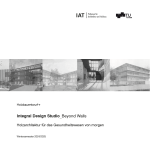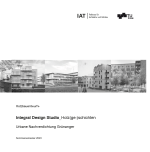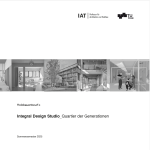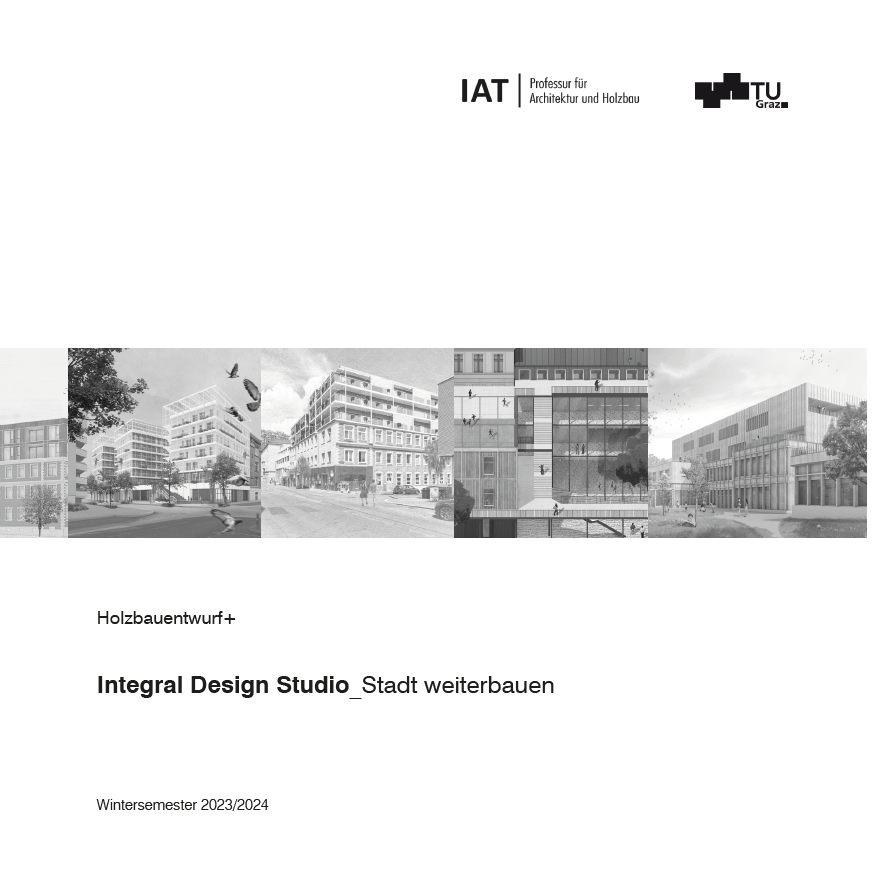
This publication documents a master’s design exercise that explores the potential of inner-city additions and consolidations using wood as a building material. The focus was on the precise handling of existing buildings and the question of how new space can be created without wasting resources or impairing the established urban fabric.
The three construction sites in Vienna’s 10th district offered different starting points: the extension of a school building, the addition to the edge of a block, and the addition of another story to an early modernist factory building. All tasks required sensitive consideration of existing structures and a reflective approach to the density of the urban space.
Wood was used as the primary construction material to enable ecological, low-emission, and efficient building. The system concept—from the joining of individual components to the planning of entire assemblies—played a central role, as did the principles of industrial prefabrication, which support fast and low-disruption construction in an urban context.
The publication brings together the projects developed during the semester and documents the range of architectural approaches. The group’s success in the proHolz Student Trophy 24 is particularly gratifying: three projects were awarded recognition prizes, and another was ranked as a replacement project.
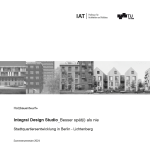
Wintersemester 2023/2024
published by: Wolfang Tom Kaden
Issue: Open Access E-Book
ISBN: 978-3-99161-083-0
Language: Deutsch
Release date: March 2026
Series: Holzbauentwurf+
This publication documents a master’s design exercise that explores the potential of inner-city additions and consolidations using wood as a building material. The focus was on the precise handling of existing buildings and the question of how new space can be created without wasting resources or impairing the established urban fabric.
The three construction sites in Vienna’s 10th district offered different starting points: the extension of a school building, the addition to the edge of a block, and the addition of another story to an early modernist factory building. All tasks required sensitive consideration of existing structures and a reflective approach to the density of the urban space.
Wood was used as the primary construction material to enable ecological, low-emission, and efficient building. The system concept—from the joining of individual components to the planning of entire assemblies—played a central role, as did the principles of industrial prefabrication, which support fast and low-disruption construction in an urban context.
The publication brings together the projects developed during the semester and documents the range of architectural approaches. The group’s success in the proHolz Student Trophy 24 is particularly gratifying: three projects were awarded recognition prizes, and another was ranked as a replacement project.