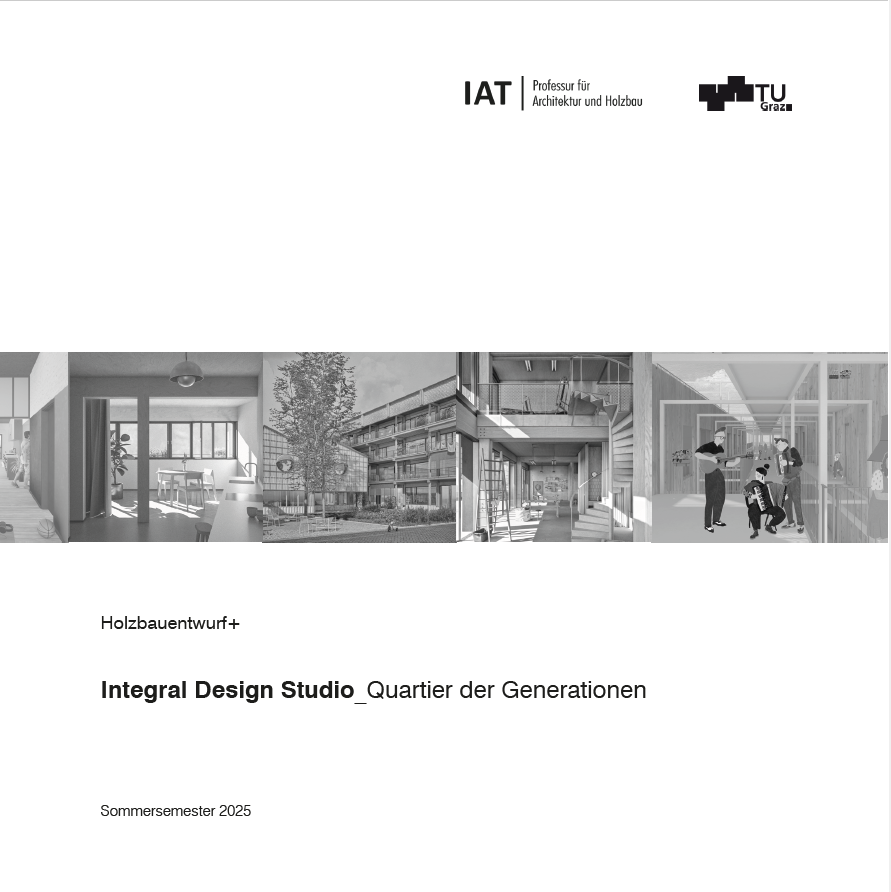
Integral Design Studio_Quartier der Generationen

Sommersemester 2025

published by: Wolfang Tom Kaden

Issue: Open Access E-Book
ISBN: 978-3-99161-081-6
Language: Deutsch
Release date: March 2026
Series: Holzbauentwurf+

The design studio focused on the transformation of the former building yard area in Schorndorf, which is being developed into a “neighborhood for generations” as part of the IBA27. A planning design space was created on approximately 1.5 hectares, in which students explored possibilities for a mixed, socially diverse, and largely car-free urban neighborhood.
The focus was on concepts for intergenerational living, precisely defined urban density, and resource-efficient construction methods. The projects examined how flexible and scalable timber construction systems can respond to different forms of living and working and what contribution they can make to the spatial and social quality of a new neighborhood.
At the same time, the area was considered as a material resource: The idea of a component warehouse, possible material cycles, and alternative energy supply systems were central elements of the planning considerations.
Questions such as the following were addressed: Which architectural structures promote intergenerational coexistence? How can communal living strengthen urban space? And what role does timber construction play as a modular, adaptable system in the design of a sustainable urban neighborhood?
The publication presents the designs developed during the semester and offers insights into the workshop that took place during the excursion to Schorndorf, as well as into the final presentation. In addition, it shows the jointly developed urban planning regulations and the key objectives that the students set for the neighborhood.
The design studio focused on the transformation of the former building yard area in Schorndorf, which is being developed into a “neighborhood for generations” as part of the IBA27. A planning design space was created on approximately 1.5 hectares, in which students explored possibilities for a mixed, socially diverse, and largely car-free urban neighborhood.
The focus was on concepts for intergenerational living, precisely defined urban density, and resource-efficient construction methods. The projects examined how flexible and scalable timber construction systems can respond to different forms of living and working and what contribution they can make to the spatial and social quality of a new neighborhood.
At the same time, the area was considered as a material resource: The idea of a component warehouse, possible material cycles, and alternative energy supply systems were central elements of the planning considerations.
Questions such as the following were addressed: Which architectural structures promote intergenerational coexistence? How can communal living strengthen urban space? And what role does timber construction play as a modular, adaptable system in the design of a sustainable urban neighborhood?
The publication presents the designs developed during the semester and offers insights into the workshop that took place during the excursion to Schorndorf, as well as into the final presentation. In addition, it shows the jointly developed urban planning regulations and the key objectives that the students set for the neighborhood.