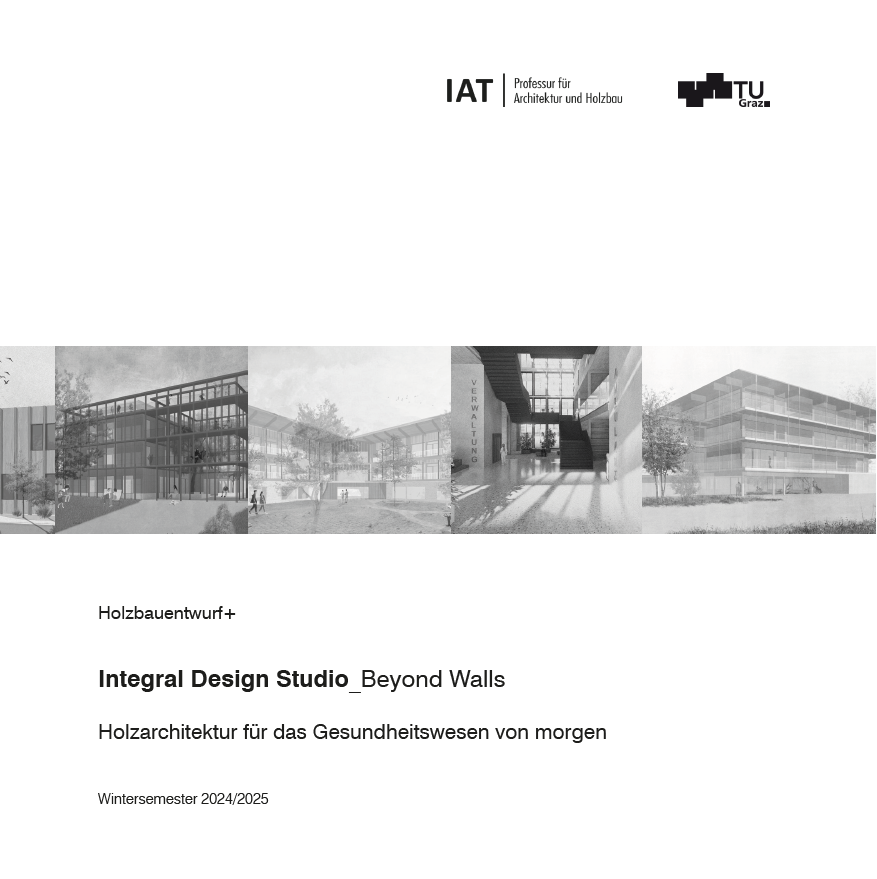
Integral Design Studio_Beyond Walls

Holzarchitektur für das Gesundheitswesen von morgen; Wintersemester 2024/2025

published by: Wolfang Tom Kaden, Stephan Brugger, Bettina Gossak-Kowalski

Issue: Open Access E-Book
ISBN: 978-3-99161-077-9
Language: Deutsch
Release date: March 2026
Series: Holzbauentwurf+

The design exercise “Beyond Walls” addressed the question of how hospital buildings can respond to technological, ecological, and social changes in the future. The focus was on developing flexible spatial systems that support medical progress as well as the needs of patients.
Based on current debates—in particular Reinier de Graaf’s approach to the “Hospital of the Future”—the students analyzed existing care models and derived strategies for durable, adaptable building structures. The focus was on the problem of architectural obsolescence as well as the potential of reduced, adaptable basic structures.
Wood construction systems formed an essential part of the planning process. Wood as a building material not only promises ecological advantages and reduced resource consumption, but also opens up possibilities for modular, expandable, and dismantlable systems. At the same time, its technical characteristics and challenges—such as sound insulation, fire protection, and structural joints—were an integral part of the planning process.
The aim of the course was to develop concepts that rethink the hospital as a future-proof, humane, and sustainable building. The resulting projects formulated different architectural responses to the question of how healthcare buildings can be designed beyond classic functional schemes—open, flexible, and focused on human well-being. 
In addition to the students’ project summaries, the publication also includes photos of the final presentation and model photographs.
The design exercise “Beyond Walls” addressed the question of how hospital buildings can respond to technological, ecological, and social changes in the future. The focus was on developing flexible spatial systems that support medical progress as well as the needs of patients.
Based on current debates—in particular Reinier de Graaf’s approach to the “Hospital of the Future”—the students analyzed existing care models and derived strategies for durable, adaptable building structures. The focus was on the problem of architectural obsolescence as well as the potential of reduced, adaptable basic structures.
Wood construction systems formed an essential part of the planning process. Wood as a building material not only promises ecological advantages and reduced resource consumption, but also opens up possibilities for modular, expandable, and dismantlable systems. At the same time, its technical characteristics and challenges—such as sound insulation, fire protection, and structural joints—were an integral part of the planning process.
The aim of the course was to develop concepts that rethink the hospital as a future-proof, humane, and sustainable building. The resulting projects formulated different architectural responses to the question of how healthcare buildings can be designed beyond classic functional schemes—open, flexible, and focused on human well-being. 
In addition to the students’ project summaries, the publication also includes photos of the final presentation and model photographs.