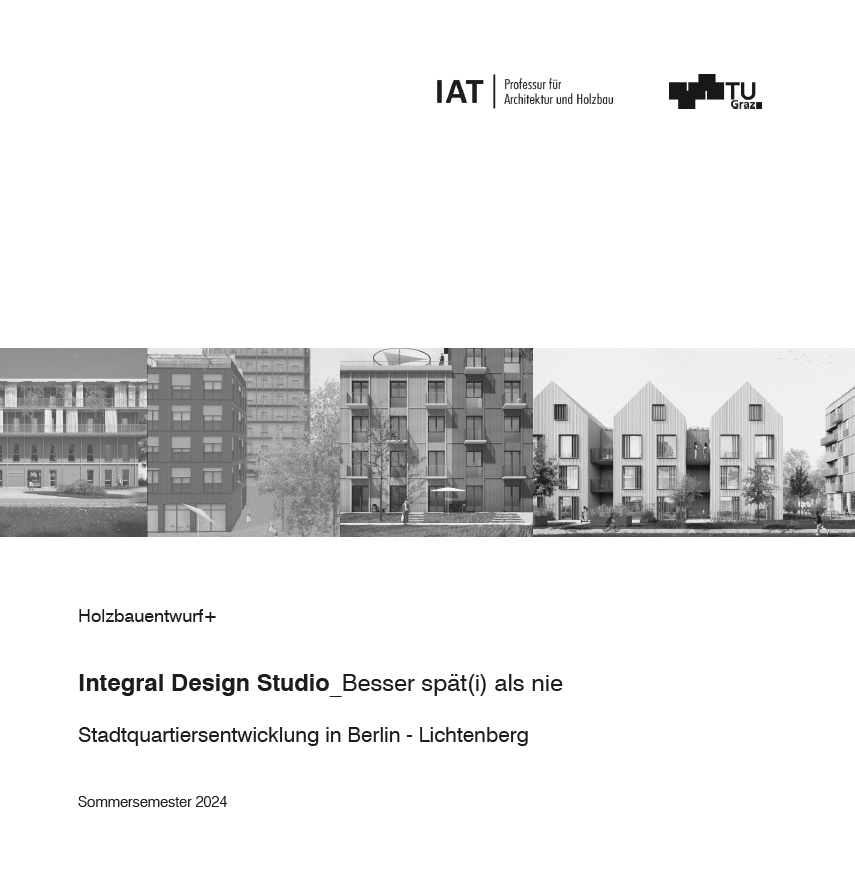
Integral Design Studio_Besser spät(i) als nie

Stadtquartiersentwicklung in Berlin - Lichtenberg; Sommersemester 2024

published by: Wolfang Tom Kaden, Bettina Gossak-Kowalski

Issue: Open Access E-Book
ISBN: 978-3-99161-075-5
Language: Deutsch
Release date: March 2026
Series: Holzbauentwurf+

This publication documents a master’s design exercise for the transformation of a 4.5-hectare site in Berlin-Lichtenberg. Today, the area is characterized by a mixture of existing buildings, open spaces, and mature vegetation. Based on this, the students developed a neighborhood that combines various types of housing, high-quality green spaces, and clear pathways.
The urban planning task ranged from modular new buildings to the further development of existing buildings. The program was supplemented by small-scale commercial uses, a daycare center, and a mobile extension for a school, which also demonstrates the possibilities of circular construction processes.
Wood played a central role in the exercise—not merely as a construction material, but as the starting point for a building method that is precisely joined, resource-efficient, and compatible with the city. The development of viable systems required an examination of component organization, assembly processes, and the question of how serially producible elements can also enable architectural diversity.
The publication presents the designs developed during the semester and illustrates how differently the spatial, ecological, and social conditions of the location were responded to. It offers insights into the joint Berlin excursion and final presentation, and also shows the urban planning regulations developed jointly by the group and the key objectives that the students set for the neighborhood.
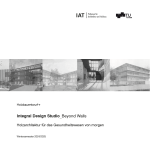
This publication documents a master’s design exercise for the transformation of a 4.5-hectare site in Berlin-Lichtenberg. Today, the area is characterized by a mixture of existing buildings, open spaces, and mature vegetation. Based on this, the students developed a neighborhood that combines various types of housing, high-quality green spaces, and clear pathways.
The urban planning task ranged from modular new buildings to the further development of existing buildings. The program was supplemented by small-scale commercial uses, a daycare center, and a mobile extension for a school, which also demonstrates the possibilities of circular construction processes.
Wood played a central role in the exercise—not merely as a construction material, but as the starting point for a building method that is precisely joined, resource-efficient, and compatible with the city. The development of viable systems required an examination of component organization, assembly processes, and the question of how serially producible elements can also enable architectural diversity.
The publication presents the designs developed during the semester and illustrates how differently the spatial, ecological, and social conditions of the location were responded to. It offers insights into the joint Berlin excursion and final presentation, and also shows the urban planning regulations developed jointly by the group and the key objectives that the students set for the neighborhood.