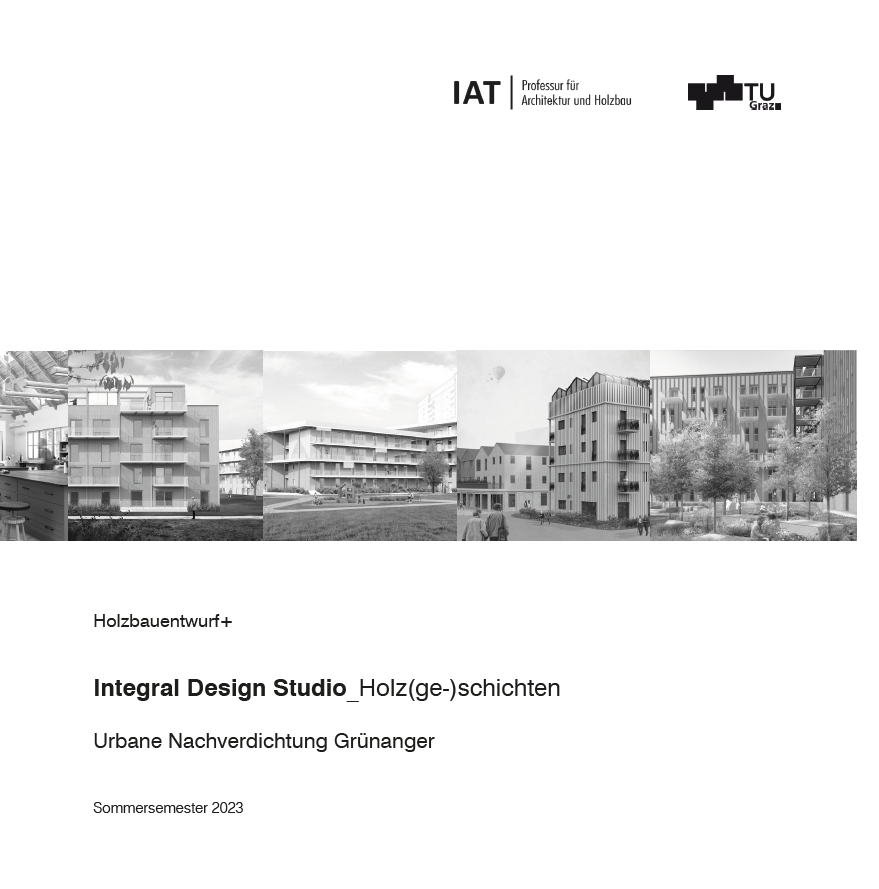
Holz(ge)schichten documents a design exercise from the Master’s program in Architecture, in which 15 students took an in-depth look at the Grünanger district of Graz. The starting point was the question of how a historically complex residential area can be redensified in a responsible, sustainable, and future-oriented manner.
The semester began with an urban analysis of the existing situation and its unique history: in the 20th century, the area was the site of the Graz-Liebenau camp, later a residential development with high potential for appropriation, and today an urban field marked by transformation. The discussion covered both the spatial qualities of the neighborhood—low density, village-like scale, spacious gardens—as well as the social conditions of a long-disadvantaged neighborhood and the complex layer of memory associated with the place.
Building on this, the students developed strategies for sustainable redensification: additions, extensions and annexes, new envelopes, new buildings, and various concepts for open spaces, mobility, and communal uses. Central questions were how to deal with the existing stock, the responsible use of resources, and the definition of a “meaningful density” for a contemporary residential neighborhood. Wood was used as the primary construction material, supported by systemic thinking and principles of industrial prefabrication—from concept to detail.
The publication brings together the course poster, a brief description of the semester topic, excerpts from the projects, and insights into the final presentation. It also shows the urban planning regulations developed jointly by the group and the key objectives that the students set for the Grünanger neighborhood.
Urbane Nachverdichtung Grünanger; Sommersemester 2023
published by: Wolfang Tom Kaden, Bettina Gossak-Kowalski
Issue: Open Access E-Book
ISBN: 978-3-99161-079-3
Language: Deutsch
Release date: March 2026
Series: Holzbauentwurf+
Holz(ge)schichten documents a design exercise from the Master’s program in Architecture, in which 15 students took an in-depth look at the Grünanger district of Graz. The starting point was the question of how a historically complex residential area can be redensified in a responsible, sustainable, and future-oriented manner.
The semester began with an urban analysis of the existing situation and its unique history: in the 20th century, the area was the site of the Graz-Liebenau camp, later a residential development with high potential for appropriation, and today an urban field marked by transformation. The discussion covered both the spatial qualities of the neighborhood—low density, village-like scale, spacious gardens—as well as the social conditions of a long-disadvantaged neighborhood and the complex layer of memory associated with the place.
Building on this, the students developed strategies for sustainable redensification: additions, extensions and annexes, new envelopes, new buildings, and various concepts for open spaces, mobility, and communal uses. Central questions were how to deal with the existing stock, the responsible use of resources, and the definition of a “meaningful density” for a contemporary residential neighborhood. Wood was used as the primary construction material, supported by systemic thinking and principles of industrial prefabrication—from concept to detail.
The publication brings together the course poster, a brief description of the semester topic, excerpts from the projects, and insights into the final presentation. It also shows the urban planning regulations developed jointly by the group and the key objectives that the students set for the Grünanger neighborhood.